Case study · Courtney & Nelson · Wholesale distribution
£22,000
estimated saving a year
The price list, built in an hour and on every rep's phone.
A web app that builds the three-weekly Price List Order Form from the stock file, and puts the same form on every rep's phone so orders reach the office in seconds and survive a dropped signal.
£22,000
estimated saving a year
770 hours
of office and rep time a year
6,000
fewer price list booklets printed a year
7 months
to pay for itself
The problem
Courtney & Nelson supplies about 750 shops across Northern Ireland, and its reps sell from the PLOF: a Price List Order Form of about 2,000 lines, reissued every three weeks. The form was slow to build, and the orders taken on it were slow to reach the office.
Every period the price list was rebuilt by hand in Excel: about 20 hours a month typing in new lines, prices and codes, and nudging sections around until the pages printed properly.
Mistakes crept in. Discontinued lines stayed on the form, new ones were missed, and more than one version of the spreadsheet was in circulation at once.
Reps wrote orders on the paper form and either handed the sheets in or phoned them through, about 15 minutes of work for each paper order on top of the visit.
The office keyed every order into the sales system from handwriting or a phone call, and about one order in ten had to be chased for an unreadable line, a wrong code, a missing quantity or a missing account.
500 booklets were printed every period.
How it worked before
The price list was an Excel workbook, rebuilt each period from the stock export and printed as a booklet. Reps marked quantities on their copy at the customer. The sheet then went to the office by hand, or the order was read out over the phone, and someone keyed it in line by line. Until it reached the office there was no record of the order anywhere but the rep's sheet.
What we did
Replaced the Excel price list (June 2026). The stock export imports in one click and updates every price, pack size and code across the 5,436-product library. Listing rules keep discontinued lines off the form, a drag-and-drop editor mirrors the printed page, and 2,294 products have a fixed home, so they place themselves each period. One click produces the print-ready A4 booklet. Nine price lists have been built this way, each about 2,000 lines.
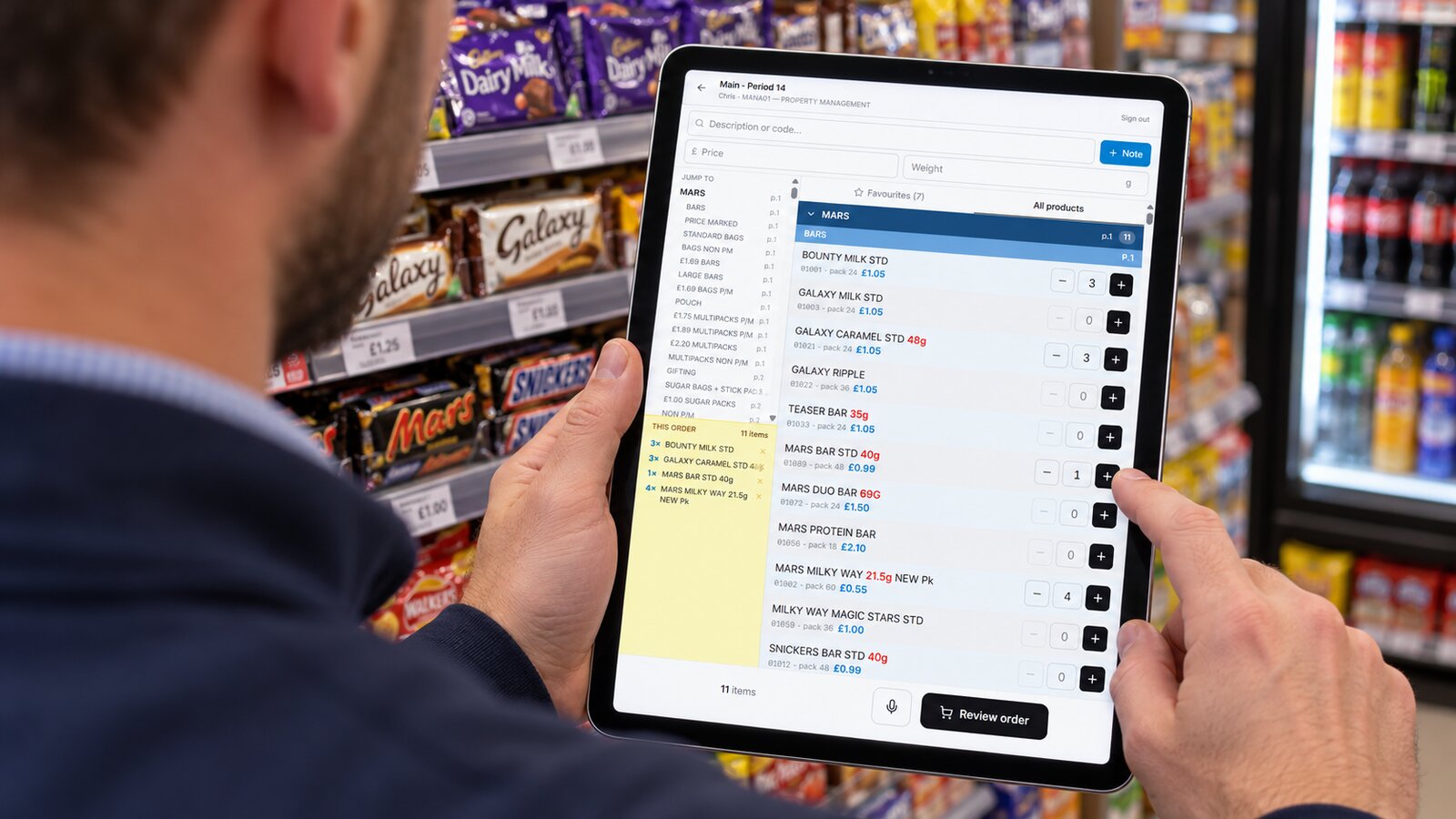
Put the same form on every rep's phone (July 2026). Reps sign in with a PIN, pick the customer (looked up from the C&N sales dashboard) and tap in quantities on a form laid out like the booklet, with the same page numbers. They can search by description, price or weight, the customer's recent orders and favourites are one tap away, and orders can be spoken in.
Made sure no order is lost. An order saves as it is keyed, on the phone and on the server. The app installs on the phone and keeps working without signal. A resent order can never arrive twice. Every order is emailed to the office, its delivery is tracked, and a failed send is retried. With no signal at all, the rep can save the order as a PDF, and unfinished orders are flagged the next time the app opens.
Closed the loop with the office. Each order arrives as a clean email with the code, pack, quantity and price of every line. One link marks it keyed and sends the rep a notification. The office can search every order by account, customer, rep or price list, and see orders that were started but not sent.
Helped reps sell. At the Confirm step, the app suggests up to three products the customer bought in their last four orders that aren't on this one. Price-marked lines are flagged, and a running list shows everything on the order so far.
Kept building as C&N asked (to October 2026): search that knows "coke" means Coca-Cola, order history for reps, posters to fill the blank pages at the back of a booklet, and safe clear-out of old periods.
Worked alongside the people using it. We build with C&N week by week, without a requirements document, so changes came straight from what the reps and the office said. Jonny McWilliams, Sales Director, put the app in the reps' hands. Rosie Lavery, Office Lead, shaped how orders land in the office.
The results
Total estimated saving: about £22,000 a year. That's about 770 hours of office and rep time, worth roughly £15,500, plus about £6,100 of printing.
Saving
Per year
How it was worked out
Building the price list
220 hours
About 20 hours a month in Excel before, and under an hour a period now, with a new list every three weeks (about 17 a year). C&N's own estimate.
Keying orders
180 hours
Five minutes to key an order from a paper sheet or a phone call, one minute from the app's email. Applied to about 2,750 app orders a year: 57 a week, measured over seven weeks, for 48 weeks. C&N's estimate of the minutes.
Rep paperwork
340 hours
Fifteen minutes for each paper order and a five-minute call for each phoned one (about a quarter were phoned), against about five minutes now. Same app orders. C&N's estimate.
Chasing unclear orders
20 hours
About one order in ten needed a five-minute chase. The app can't send an unreadable line, an unknown code or an order with no account. C&N's estimate, modelled.
Printing
£6,100
500 booklets a period down to 150, at about £1 each, over about 17 periods a year. C&N's figures.
Total
£22,000
Estimated, per year
The order savings count only orders sent through the app. About a quarter of rep orders still arrive on paper or by phone, so the saving grows as those move across.
Other improvements
Every order arrives. All 452 orders sent in the last eight weeks were delivered to the orders inbox and none bounced. Half arrived within 3.5 seconds of the rep pressing send.
Orders go when they are taken. 93 of the 452, one in five, were sent before 8am or after 5pm, and were in the office inbox at once rather than waiting for a sheet to be handed in.
The office tells the rep. Of the 155 orders marked keyed, half were marked within five minutes of being sent, and the rep can be notified on their phone when it happens.
149 customer accounts ordered through the app in the last eight weeks. A typical order is 25 lines. The largest was 279.
The booklet and the app agree. Both are built from the same list, with the same prices and the same page numbers, so a rep can say "page 12" to a customer holding the printed copy.
No order is lost to a dropped signal. It is saved on the phone and on the server as it is keyed, and an unfinished order is flagged the next time the app is opened.
What C&N say
"
Our reps used to write orders on the paper PLOF and then either drop the sheets in or ring them through. Now the order goes from the shop to the office in seconds, from the same PLOF the customer has in their hand, and it isn't lost if the signal drops. The reps spend their time selling, not doing paperwork.
Jonny McWilliams, Sales Director, Courtney & Nelson
"
With paper orders I was working out handwriting and ringing reps back about codes and quantities. Now every order lands in the inbox the same way, with the right codes, I key it in a minute, and one click tells the rep it's done.
 Verona AI