Cut Waste, Tighten Specs and Stop Losing Margin to Batches That Should Never Have Left the Line: Practical AI tools Northern Ireland food manufacturers, production managers and technical teams can put to work right now
In a food plant, margin lives and dies in the gap between what the spec says and what actually leaves the line. AI built on your own production data can close that gap before the batch does.
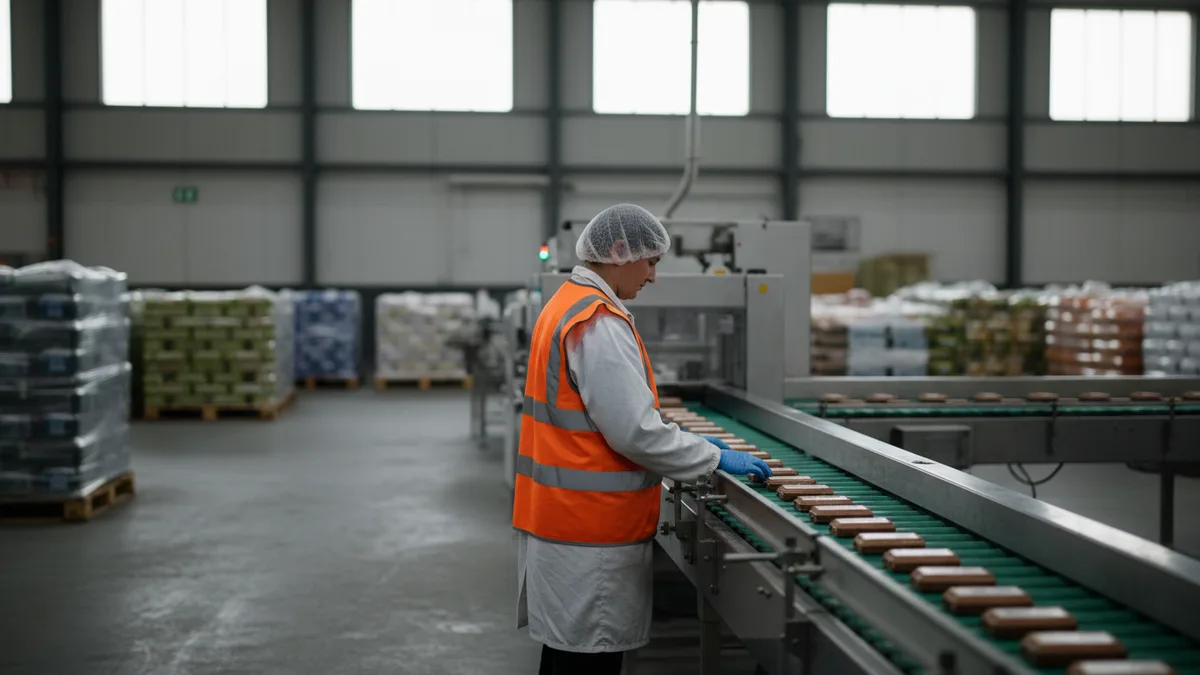
Food manufacturing in Northern Ireland is quietly one of the most technically demanding industries on the island. From the chicken processing lines in Co. Tyrone to the dairy operations in Co. Antrim and the bakery and prepared-foods businesses spread across Greater Belfast, these are plants running on tight margins, tight specifications and a regulatory environment that does not forgive mistakes. A failed audit, a customer complaint about a weight or allergen labelling issue, a batch pulled back from a retailer shelf: any one of those events can wipe out a week of profit in a single afternoon.
What is frustrating is that most of the information needed to prevent those events already exists inside the business. It sits in batch records, in quality control logs, in ERP exports, in spreadsheets the line supervisor updates at shift changeover, in PDFs from the lab, in emails from the retailer technical team. The problem is not a shortage of data. The problem is that the data is scattered, it arrives too late to act on, and nobody has the time or the tools to join it up. That is the gap AI is starting to close, and it is happening in plants that look very much like yours.
Why Northern Ireland food manufacturers face a specific set of pressures
The Northern Ireland food sector punches well above its weight. Agri-food is the largest manufacturing sector in the region, accounting for roughly a quarter of all manufacturing turnover. But size brings exposure. Many local producers supply directly into the major GB and Republic of Ireland multiples, where retailer technical standards are exacting and where a Category B non-conformance on a supplier audit can trigger a review of the entire trading relationship.
At the same time, input costs have remained volatile. Energy, packaging and raw material prices have shifted repeatedly over the past few years, which means the margin calculation that held in January may not hold in March. Producers who can track yield, waste and rework in close to real time are in a fundamentally different position to those still waiting for a monthly management accounts pack to tell them what happened six weeks ago.
Add in the workforce dimension and the picture gets harder still. Experienced line managers carry a huge amount of institutional knowledge in their heads. When they move on, that knowledge goes with them. A private AI system that has been trained on years of production records, quality logs and supplier data does not retire or hand in its notice.
Where the margin actually leaks
Walk the floor of almost any food plant and the waste is visible if you know what to look for. Overfill on pack weights is one of the most persistent and underappreciated drains on margin. A ready-meal line running two grams heavy across a shift does not sound dramatic until you multiply it across 40,000 units and then across 250 production days. That is real product given away for nothing, and it rarely shows up clearly in the P and L because it is buried inside yield variance.
Rework is the other one. Product that comes off the line out of spec, gets stripped and reprocessed costs time, labour and energy. More importantly, it is usually predictable. The conditions that lead to a rework event, an ingredient delivery that was slightly off moisture content, a sealer temperature that drifted during the night shift, a changeover that ran long, tend to leave a trail in the data before the problem becomes visible on the line. The difficulty is that no one is watching all those signals at once.
Allergen and labelling compliance is a third area where the cost of getting it wrong is not just financial. The regulatory and reputational consequences of an allergen incident are severe. Most plants have robust procedures on paper. The gap is in execution: a packaging changeover that happened faster than the paperwork, a raw material substitution that was logged in the ERP but never flagged to the technical team. These are process and information problems, and they are exactly the kind of problem a well-configured AI system can monitor continuously.
What a private AI system actually does inside a food plant
The starting point is not a chatbot. It is a platform installed inside your own environment, connected to the systems you already run. That might be your ERP, your quality management system, your batch records in whatever format they currently exist, your supplier documentation, your retailer technical portal exports, your lab results. The AI reads across all of it.
From there, the applications depend on where your biggest pain points sit. For a production manager at a cooked meats facility outside Dungannon, the most valuable first application might be a live yield dashboard that pulls from the line weighing system and the ERP and flags when a product family is tracking outside its target range, with enough context to suggest whether the issue is in the raw material intake, the process parameters or the packaging stage. For a technical manager at a dairy plant near Ballymena, it might be an automated compliance check that reads incoming supplier certificates against your approved supplier specifications and raises an exception when something does not match, before the intake is signed off.
The point is that the system works on your data, inside your walls. Nothing goes to a public AI tool. A commercially sensitive recipe, a retailer-specific specification, a supplier pricing arrangement: none of it leaves your environment. That matters in a sector where your technical IP is genuinely valuable and where retailer relationships depend on confidentiality.
Why this matters specifically for Northern Ireland
Northern Ireland food businesses operate in a dual-market environment that creates both opportunity and complexity. Access to the GB market and the all-island market simultaneously is a genuine commercial advantage, but it also means navigating two sets of retailer expectations, two regulatory contexts in some areas, and logistics arrangements that require careful planning.
The businesses that will manage that complexity most effectively over the next five years will be the ones that have the best visibility into their own operations. Not the ones with the biggest IT budgets, but the ones that have connected their existing data into something they can actually act on. A mid-sized food producer with 80 staff and a well-configured private AI system can have better operational intelligence than a much larger competitor still running on weekly spreadsheet reports.
There is also a talent dimension. The competition for experienced food technologists, production planners and quality managers in Northern Ireland is real. If your AI system is handling the routine monitoring, the document checking and the report generation, your technical people can focus on the work that actually needs their judgement. That makes the roles more interesting and the business more resilient.
Where to start
The worst way to approach this is to try to solve everything at once. A full digital transformation programme that touches every system in the plant is expensive, slow and usually disappointing. The better approach is to pick one process where the cost of the current problem is clear and the data to address it already exists somewhere in the business.
Good candidates in a food manufacturing context are usually one of three things. First, a quality or yield metric that is consistently worse than it should be and where you suspect the answer is in the data but nobody has the time to look properly. Second, a compliance or documentation process that is currently manual, error-prone and takes skilled people away from higher-value work. Third, a reporting process that produces information too slowly to be useful, where the management team is always looking at last month rather than this week.
An AI Discovery with Verona starts there. It is a structured audit of your systems, your data and your processes, and it produces a costed, ranked plan that tells you which application will deliver the clearest return first. You are not signing up for a long programme. You are finding out what is possible and what it would actually cost, based on how your business works today. From there, implementation is focused on that first application, getting it live and measuring the result before anything else is built.
Most food manufacturers who go through that process find the first application pays for itself within a few months, because the problem it solves was already costing real money. The platform is then in place for the next one.
Want to see where AI would make the biggest difference in your plant?
Book a free 30-minute conversation with Verona AI. We will look at your production process and show you what a private AI system, built on your own data, could realistically do in the first 90 days.
Book a free consultationMore from the Verona AI blog
Build Smarter, Quote Tighter and Stop Losing Margin to Projects That Go Wrong Before the First Spade Hits the Ground: Practical AI tools Northern Ireland contractors, quantity surveyors and site managers can put to work right now
Discover practical AI tools for Northern Ireland construction firms: smarter estimating, safer sites and better project control without the tech overwhelm.

Deliver More, Waste Less and Stop Losing Margin to Routes Planned on Yesterday's Road Map: Practical AI tools Northern Ireland hauliers, freight forwarders and fleet managers can put to work right now
Discover how AI tools are cutting fuel waste, improving delivery times and boosting margins for Northern Ireland hauliers and logistics firms.

Stock Smarter, Price Sharper and Stop Losing Margin to Shelves That Tell You Nothing: Practical AI tools Northern Ireland retailers, buyers and store managers can put to work right now
Northern Ireland retailers are leaving money on the shelf. Discover practical AI tools for smarter stock, sharper pricing and real customer insight.